

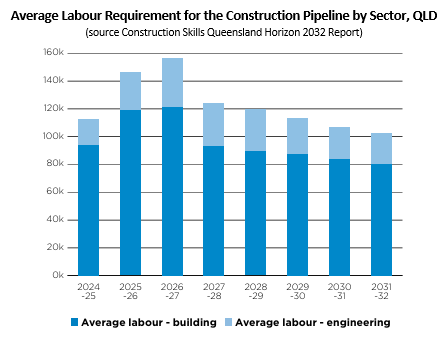
Construction is now Queensland’s third largest industry, behind mining and healthcare & social assistance. As Brisbane prepares to host the 2032 Olympic and Paralympic Games, the Construction Skills Queensland Horizon 2032 report forecasts a peak in demand for construction-related labour as early as next financial year, with a projected shortfall of around 50,000 workers at peak demand.
Queensland’s Deputy Premier Jarrod Bleijie underscored the scale of the challenge, stating that government would “beg, borrow, and steal” to secure the workers required to deliver infrastructure for the Games.
What this means for Queensland SMEs
While Games-related construction will generate significant economic opportunity, the flow-on effects for small and medium-sized enterprises (SMEs) are likely to be substantial:
- Intensifying competition for skilled labour
- Upward pressure on wages and operating costs
- Project delays and capacity constraints
- Greater reliance on workforce planning and alternative solutions
The Games construction pipeline isn’t just a headline event — it’s a structural shift in Queensland’s labour market.
If you are concerned about impacts on your own workforce, consider practical actions that can be taken now to better position yourself for competition peaks:
- Stress-test your workforce – identify the roles you cannot afford to lose.
- Lock in key staff – review pay positioning against the market (not just Award), consider retention incentives and conduct stay-interviews with high performers.
- Build your own pipeline – engage apprentices early and strengthen partnerships with training providers, industry groups and recruitment partners, before demand peaks and availability tightens.
- Improve workforce flexibility – cross-skill staff where possible and document processes so work doesn’t stop if someone leaves.
- Get realistic about lead times – assume longer hiring timeframes.
- Price for labour volatility – where possible include labour-cost variation clauses and factor in overtime, fatigue management and compliance costs.
For SMEs, early planning, competitive employment strategies and proactive workforce partnerships will be critical to staying resilient as competition for skilled workers accelerates across the state. When the labour market is at its tightest, the worst position to be in is starting from scratch.
Top Office Group works closely with Queensland SMEs to support workforce planning, attraction strategies and flexible recruitment solutions in tightening labour markets. If labour availability, retention risks or delivery capacity are already on your radar, now is the time to take a proactive approach. Reach out to us on 07 3812 2920 or email recruitment@topoffice.com.au about how early workforce planning and targeted recruitment strategies can help your business stay competitive.